Banglar Yuva Sathi: TMC's Aid Scheme Ignites Pre-Election Debate in West Bengal
The political landscape of West Bengal is once again abuzz, stirred by the Trinamool Congress (TMC) government's latest initiative, the Banglar Yuva Sathi scheme. Announced in the state's interim budget and fast-tracked for implementation, this scheme promises a monthly financial assistance of ₹1,500 to unemployed youth, aiming to provide crucial support during their job search. While the initiative has been met with overwhelming public enthusiasm, drawing thousands to registration camps across the state, it has simultaneously ignited a fierce political controversy, with the opposition branding it as an election-eve 'eyewash' and a rehashed version of previous schemes.
As election season looms, the timing of such a significant welfare program naturally draws scrutiny. Is Banglar Yuva Sathi a genuine effort to empower the state's jobless youth, or a strategic move to secure votes? This article delves into the details of the scheme, the public's response, the political accusations, and the broader implications for West Bengal.
Understanding the Banglar Yuva Sathi Scheme
At its core, the Banglar Yuva Sathi is a welfare scheme designed to alleviate the financial burden on unemployed residents of West Bengal. Spearheaded by Chief Minister Mamata Banerjee, the program offers a lifeline to a demographic often struggling with economic uncertainty.
- Target Beneficiaries: The scheme targets unemployed individuals residing in West Bengal.
- Age Criteria: Applicants must be between 21 and 40 years of age. This specific age bracket aims to support those transitioning from education into the workforce or actively seeking employment in their prime working years.
- Educational Qualification: A minimum qualification of having passed the Madhyamik (secondary) examinations is required, ensuring a foundational level of education among beneficiaries.
- Financial Assistance: Eligible applicants will receive ₹1,500 per month. This assistance is provided for a period of five years or until the beneficiary secures a job, whichever comes first. The intent is to offer sustained support without fostering long-term dependency.
- Exclusivity: Crucially, beneficiaries must not be availing themselves of other government assistance schemes that provide similar financial support, ensuring that aid reaches a broader segment of the unemployed population.
- Implementation Schedule: Initially slated for implementation in August, the government preponed the scheme's launch, now scheduled to come into effect from April 1. This expedited timeline has been a significant point of contention for the opposition.
- Budgetary Allocation: The state government has allocated a substantial ₹5000 crores for the scheme, underscoring its commitment to the program.
The scheme requires applicants to submit a self-declaration of unemployment, streamlining the process while placing the onus of truthfulness on the individual. The financial aid is directly credited to bank accounts linked to the applicant's Aadhaar card, promoting transparency and reducing the scope for intermediaries.
The Tremendous Response: A Snapshot of Public Enthusiasm
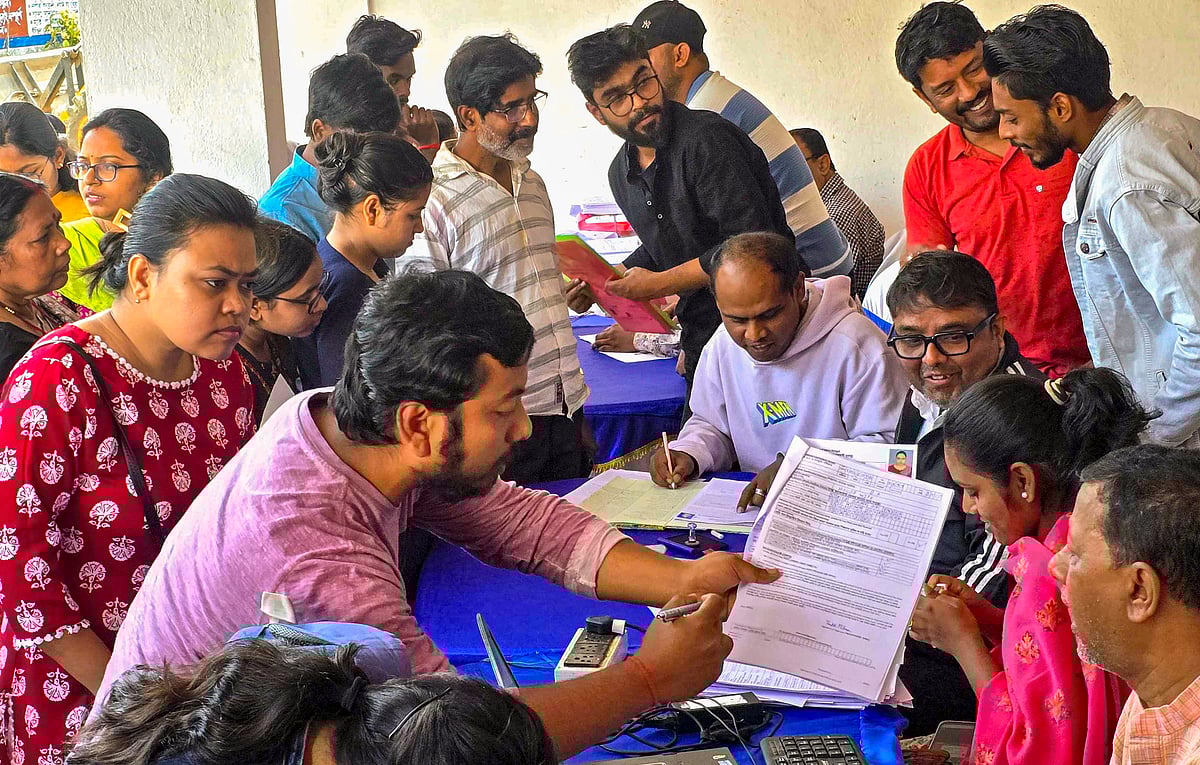
The announcement and subsequent registration drive for Banglar Yuva Sathi triggered an immediate and overwhelming response across West Bengal. From February 15 to February 26, designated camps in all 294 constituencies witnessed unprecedented crowds, with thousands queuing up daily, eager to secure their forms.
Anecdotal evidence from places like Hooghly highlights the palpable excitement. Chanchal, a 41-year-old local, expressed his disappointment at just missing the age cut-off, illustrating the widespread desire to benefit from the scheme. His barber, a 34-year-old planning to register himself, echoed the sentiment, seeing it as an "opportune moment" to receive aid just before the elections.
The sheer scale of public participation is staggering. According to official sources, on February 16 alone, 22,000 forms were distributed from just 35 camps in Kolkata. Over the first two days of registration, approximately 6.55 lakh forms were distributed across Bengal. These numbers underscore the severe challenge of unemployment in the state and the desperate need for financial relief among its youth. The sight of long queues, as captured in reports, vividly portrays the hopes and aspirations pinned on this initiative. For more details on the public's response, you can read about how Banglar Yuva Sathi Scheme: Crowds Flock for ₹1500 Monthly Aid.
Political Crossfire: Aid or Election Gimmick?
While the crowds speak of hope, the political arena echoes with accusations and counter-accusations. The timing of the Banglar Yuva Sathi scheme, just ahead of crucial elections, has predictably become a hotbed of debate.
The Opposition's Stance: BJP's Allegations
Leader of Opposition and BJP stalwart, Suvendu Adhikari, has been particularly vocal in his criticism. He accused the TMC government of merely "rehashing" its earlier 'Yuvashree' scheme, whose funds, he claims, have been blocked. "It is the same old tactic of reintroducing the same scheme with a new name," Adhikari stated, suggesting a lack of innovation and genuine intent.
Adhikari went further, painting a grim picture of West Bengal as a "bankrupt state" suffering from capital flight and lack of investment, where "the true appreciation of talent is non-existent." In this context, he branded Banglar Yuva Sathi as "yet another ploy of the state government to make unemployed youths stand in queues for submitting the applications." The preponement of the scheme's implementation date also drew sharp criticism, with the opposition labeling it as an "eyewash" and "targeted doles ahead of elections." The implication is clear: the scheme is perceived not as sincere welfare but as a strategic maneuver to garner electoral support.
TMC's Defense: Upholding Welfare Commitments
The Trinamool Congress has vehemently dismissed these claims. Finance Minister Chandrima Bhattacharya retorted by accusing the Centre of withholding crucial dues owed to the state, thereby creating fiscal constraints. Despite these challenges, Bhattacharya emphasized the TMC government's unwavering commitment to welfare schemes, asserting that such initiatives would continue.
Regarding the nature of Banglar Yuva Sathi, she clarified, "In the Yuva Sathi scheme we are actually giving financial assistance. It's not something only to cover up the unemployment, not a question of unemployment. Think of a student who has passed Madhyamik (Class X) - the basic requirement for getting into the scheme." This statement suggests a broader vision for the scheme, one that supports individuals not just during unemployment but also as they seek to build their careers post-secondary education.
This political tug-of-war is characteristic of the Indian democratic process, where welfare schemes are often viewed through a dual lens: as essential social support and as powerful political tools. While the government highlights its commitment to citizens, the opposition questions the timing and underlying motives, keeping the debate alive.
Navigating the Application Process for Banglar Yuva Sathi
For those interested in applying for the Banglar Yuva Sathi scheme, understanding the application process and requirements is paramount. The government has tried to make the process accessible, though gathering the necessary documents is crucial.
Key Requirements for Application:
- Filled-out Application Form: Available at designated registration camps.
- Aadhaar Card: Essential for identity verification and linking with bank accounts.
- Voter ID Card: Proof of residency and age.
- Madhyamik (Class X) Pass Certificate and Admit Card: To verify educational qualification and age.
- Bank Document: This could be a passbook front page or a cancelled cheque, indicating an active bank account linked to the applicant's Aadhaar for direct benefit transfer.
- Self-Declaration of Unemployment: A formal declaration affirming the applicant's unemployed status and non-receipt of other government aid.
Practical Tips for Applicants:
- Prepare Documents in Advance: Gather all required documents, including originals and several photocopies, before heading to the registration camps.
- Verify Aadhaar-Bank Link: Ensure your Aadhaar card is correctly linked to your bank account to facilitate seamless monthly payments. This is a common pitfall for many applicants in government schemes.
- Check Eligibility Meticulously: Double-check all age, education, and other eligibility criteria to avoid wasted effort.
- Stay Informed: Keep an eye on official announcements from the West Bengal government portals for any updates or changes to the scheme.
- Beware of Scams: Be cautious of unofficial channels or individuals promising expedited processing for a fee. All official services are free or have transparent charges.
The registration camps were scheduled to continue until February 26, providing a window for eligible youth to apply. For a comprehensive guide on eligibility criteria, benefits, and how to apply for the ₹1,500 monthly assistance, refer to our detailed article: Banglar Yuva Sathi: Eligibility, Benefits & How to Apply for Rs 1500.
Broader Implications and Future Outlook
The Banglar Yuva Sathi scheme carries significant implications, both social and economic, for West Bengal. For the individual beneficiary, ₹1,500 monthly can be more than just a dole; it can be a crucial support system. This amount could help cover expenses for competitive exam coaching, travel for job interviews, purchase study materials, or simply contribute to household necessities, thereby reducing immediate financial stress during a critical phase of life.
Economically, the injection of ₹5000 crores into the state's economy, distributed among hundreds of thousands of youth, will undoubtedly stimulate local consumption, albeit on a moderate scale. However, the long-term sustainability of such large-scale welfare programs, especially in a state facing fiscal challenges, remains a point of debate. The opposition's assertion of a "bankrupt state" raises legitimate questions about how such schemes are financed and their impact on the state's overall economic health.
Beyond immediate financial aid, the success of Banglar Yuva Sathi in addressing the root cause of unemployment will depend on complementary government initiatives. Financial assistance is a temporary measure; sustained economic growth, attraction of investments, skill development programs tailored to market demands, and robust employment generation strategies are crucial for truly empowering the youth and moving beyond a dole-based economy. The scheme provides a valuable breathing space, but the long-term goal must be to equip the youth to secure stable and meaningful employment rather than relying on government aid.
Conclusion
The Banglar Yuva Sathi scheme stands as a prominent feature in West Bengal's current political and social landscape. It represents the TMC government's commitment to supporting its unemployed youth with tangible financial assistance, evidenced by the massive public turnout at registration camps. Yet, its timing and nature have inevitably drawn sharp criticism from the opposition, framing it as a politically motivated move ahead of elections.
As the scheme moves towards its implementation from April 1, its impact will be closely watched – both for its effectiveness in aiding job-seeking youth and its potential influence on the state's political future. Ultimately, while providing immediate relief, the true success of Banglar Yuva Sathi will depend on how it integrates with broader strategies for sustainable job creation and economic development in West Bengal.